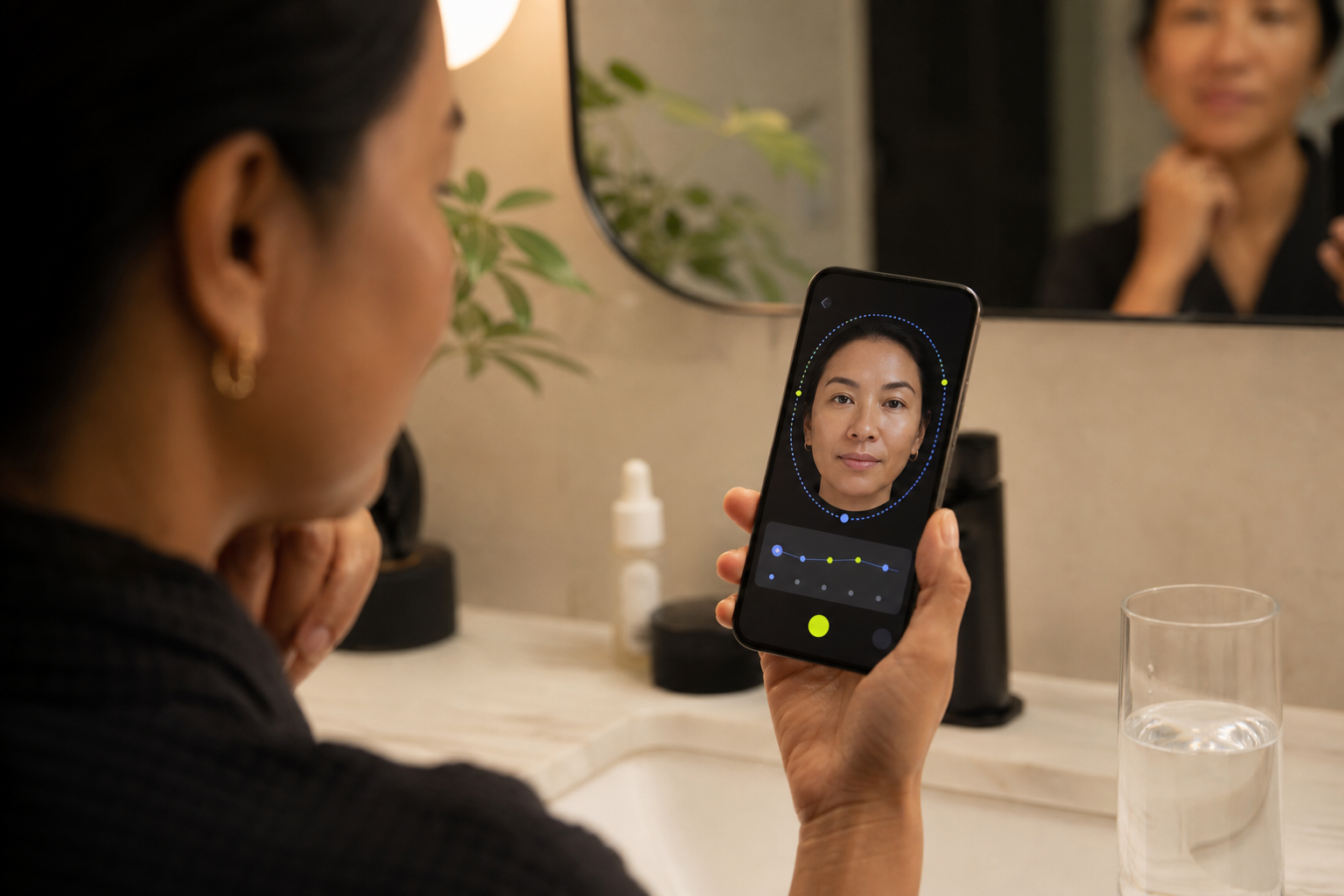
Skin changes are difficult to remember accurately. Lighting shifts, camera angles vary and yesterday's impression quickly replaces last month's baseline. A daily record could make that history easier to review without pretending a phone camera can diagnose a condition.
The Life's Capsule concept would guide a user through a consistent face scan, then pair the image with optional notes about products, sleep, stress, hydration, food, weather, symptoms and medication changes. The value would come from the timeline, not a one-time score.
Any recommendation would need careful limits. The app could suggest routine questions or flag a visible change worth discussing, but it should not name a disease, replace a clinician or tell a person to change medication.
Start with a repeatable daily scan
A useful tracking tool needs a stable baseline. The camera guide could help a user hold the phone at a similar distance, keep the face inside the same frame and note when lighting is too different for a fair comparison.
The scan would save a private image and a small set of observable changes. It should describe what the camera can see without turning that description into a diagnosis or certainty.
Put the image beside the day that produced it
A photo alone cannot explain why skin changed. A lightweight log could let a person record sleep, stress, exercise, sun exposure, new products and other lifestyle shifts. Medication notes could provide context for a conversation with a clinician, never instructions to start or stop treatment.
Over time, the timeline could surface correlations for the user to review. A pattern is a prompt for a better question, not proof of cause and effect.
Recommendations need visible boundaries
The safest recommendations would stay practical and reversible: keep the routine consistent, review a possible irritant, protect the skin from sun exposure or prepare a clear timeline for a professional appointment.
The interface should make uncertainty obvious. If an image is blurry, lighting changed or too little history exists, the app should say so instead of filling the gap with a confident score.
- No diagnosis or medication changes.
- No guaranteed claims about a product result.
- Clear escalation language for urgent or persistent concerns.
- Exportable history the user can choose to share with a clinician.
Privacy is part of the product
Face images and health-related notes are sensitive even when an app is not a medical device. The concept should explain where files are stored, whether any analysis leaves the device and how a person can export or permanently delete the record.
Daily tracking works only when people trust the system enough to use it honestly. A short privacy explanation, conservative defaults and control over every category of data are core features, not legal copy added at the end.